Accounting That Finally Makes Sense.
The free visual guide to Principles of Accounting — debits, credits, the full cycle, and beyond — through clear explanations and interactive practice.
Why Most Students Struggle With Accounting
Rules Without the Why
"Debit increases assets" is easy to memorize and hard to trust on an exam. Without the why, every new transaction feels like a fresh guess.
The Pieces Don't Connect
You can record an entry on paper, but it's harder to see how that entry shows up on the income statement, balance sheet, and cash flow statement.
Class Moves On. You Need Another Pass.
Lectures cover a lot in a short window. Having a place to slow down, practice, and re-work the same idea at your own pace makes a real difference.
How You'll Actually Learn Accounting
Start with a Real Business Scenario
You're running a small business. You just sold $5,000 of inventory on credit. What's the journal entry? We'll walk you through it step by step.
Make the Moves, Get Instant Feedback
You decide: Debit Accounts Receivable. Credit Sales Revenue. See the journal entry form in real-time. Get instant feedback if you're right—or hints if you need help. No guessing game.
Watch Financial Statements Build Live
As you record transactions, the Income Statement, Balance Sheet, and Cash Flow Statement update so you can see where each entry lands — not just that it "balanced."
Practice Until It Sticks
Work through scenarios at your own pace. Repeat the ones that feel shaky. Different transactions, same logic — until the cycle feels familiar.
The Difference Between Memorizing and Understanding
7 interactive labs. Free. No signup required.
Each lab is constraint-based — you can't move forward until the math balances. Wrong guesses get checked; right ones keep you moving.
Taco Truck Tycoon
NewRun a taco truck. Record real journal entries. Build financial statements from scratch.
Bank Reconciliation Detective
NewSolve why the bank balance doesn't match. Outstanding checks. Deposits in transit.
Debits & Credits Blitz
60 seconds. Normal balances. Train your brain to recognize accounts on instinct.
Financial Statements Map
Drag and drop the lines that connect the income statement to the balance sheet.
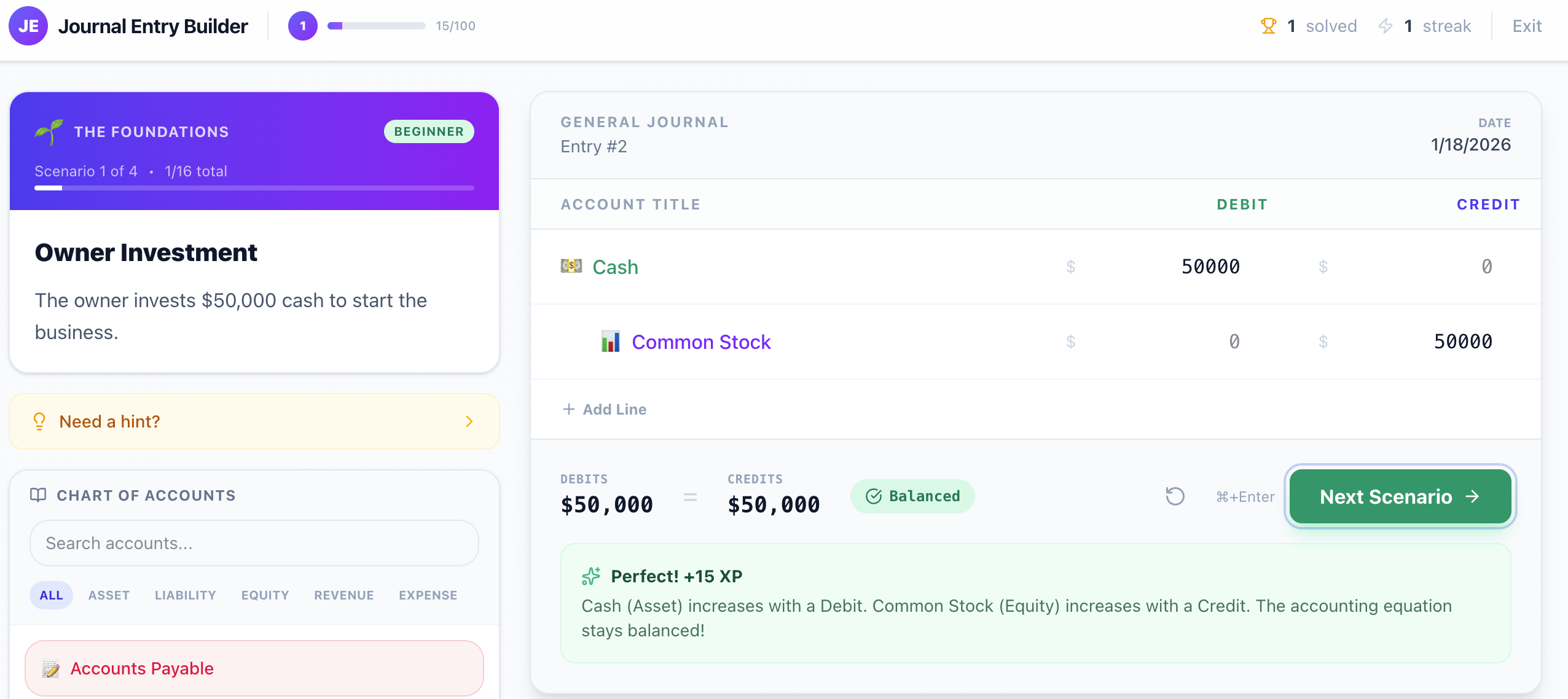
Journal Entry Constructor
Build entries step by step. Watch the accounting equation update in real time.
The Accounting Cycle
NewInteractive step-by-step wheel. Master all 10 steps of the accounting cycle.
12-Day CFO Sprint
Run a startup for 12 virtual days. Book every entry. Survive the audit.
Everything You'll Learn
The Accounting Cycle
From analyzing transactions to closing entries — the complete flow, visually.
Debits & Credits
Why debits increase some accounts and decrease others — tied back to the equation.
Financial Statements
See how journal entries show up on the income statement, balance sheet, and cash flow statement.
Managerial, Tax, Excel & Analysis
Go past the basics into costing, ratios, tax concepts, Excel workflows, and more — still in plain language.
AI in Accounting
How AI shows up in the work — explained for accountants, without the hype.
Interactive Labs
Hands-on practice — journal entries, bank recs, the cycle, and more — free to try.
Classroom Experience. Real Questions.
Built by a CPA with 18+ years of real-world accounting and classroom teaching. After watching hundreds of students memorize rules they didn't understand, I built the resource I wished existed. Every explanation on this site comes from real student questions.
Questions? We've Got Answers
New labs drop every month.
Get notified when we ship new simulations, concept breakdowns, and practice tools. No spam — just accounting content worth opening.
Join 500+ students and instructors already subscribed. Unsubscribe anytime.